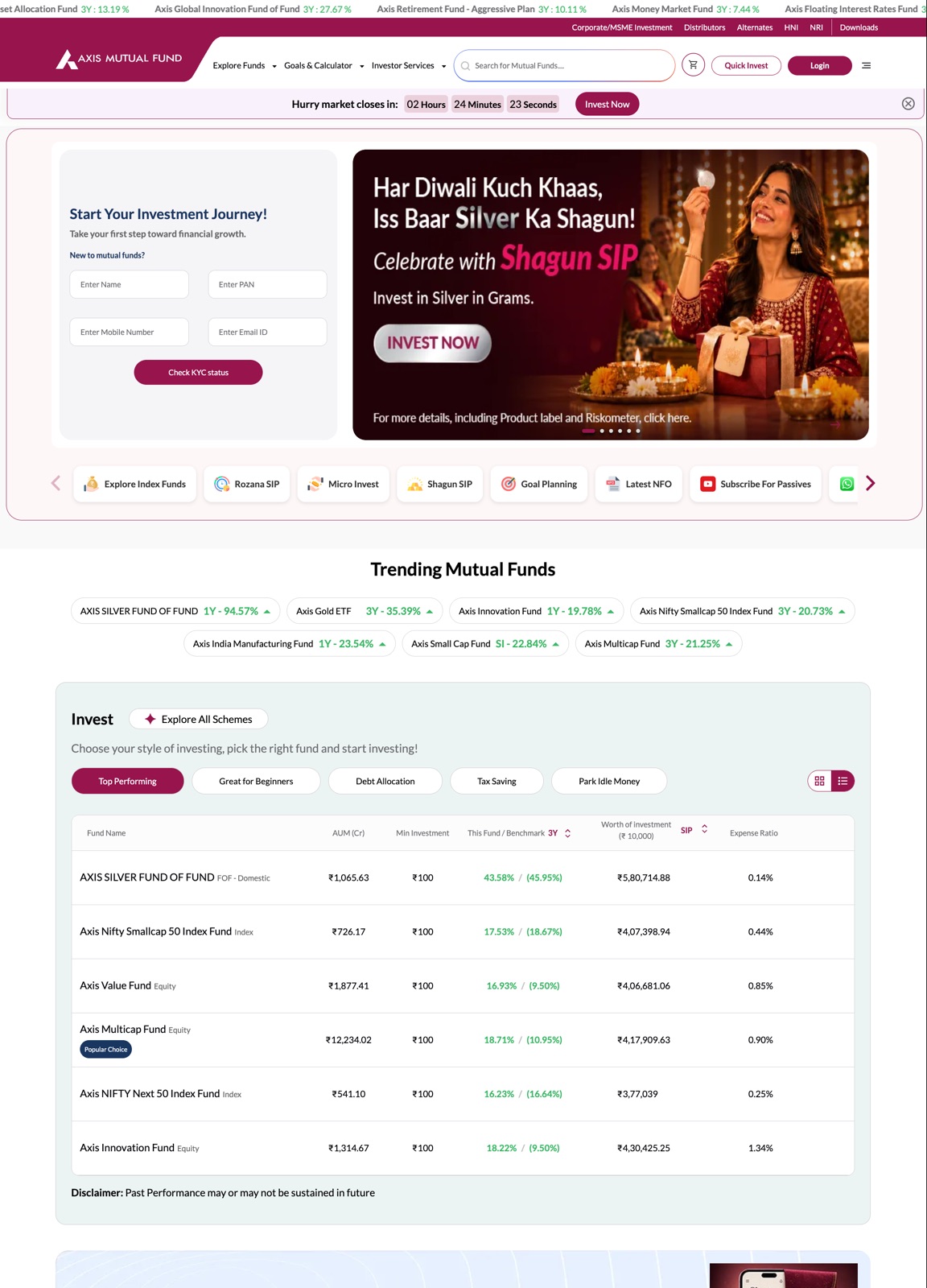
Ten funds for the price of one decision: how ₹1,000 brought first-time investors in
We had a year to add new investors and hit a set number of SIP registrations, and the usual playbook wasn't going to get us there. So I proposed a smaller first step: start with ₹1,000, spread across ten funds, in one checkout.
- Role: Ideated & led design
- Platform: axismf.com
- Reach: Multiple Indian languages
- +53%
Digital AUM
Year on year - +23%
New SIP registrations
After launch - Hit
Annual SIP target
Reached within the year
The business problem
Two numbers had to move in the same year, and both depended on people who had never invested before.
More new PANs
Every first-time investor brings a new PAN to the fund house. Growth meant reaching people who had never held a mutual fund.
The annual SIP target
A set number of new SIP registrations by year end: recurring investments that compound for the investor and the business.
The normal path fell short
Campaigns and the regular one-fund purchase flow were adding SIPs one at a time. At that pace, the year would end below target.
Why first-time investors weren't starting
Where to start?
Too many schemes, no obvious first pick
Choosing one fund out of dozens felt like a test new investors could fail, so many didn't take it.
Too big a step
A regular SIP felt like a commitment
Putting a meaningful amount into a single fund felt risky for someone still learning how markets move.
Ten funds, ten checkouts
Diversifying meant repeating the flow
Spreading money across funds meant filling the purchase and mandate flow again for every single scheme.
The idea
First-time investors didn't lack money. They lacked a small, safe first step. What if ₹1,000 could buy a slice of ten funds at once, so diversification stopped being something only big investors could afford?
Try the split
One amount, divided evenly. Change it and watch the basket rebalance.
Pick an amount
Spread it across
- Axis Large Cap₹100
- Axis Flexi Cap₹100
- Axis Multicap₹100
- Axis Mid Cap₹100
- Axis Small Cap₹100
- Axis Nifty 50 Index₹100
- Axis Balanced Advantage₹100
- Axis Multi Asset Allocation₹100
- Axis Gold₹100
- Axis ELSS Tax Saver₹100
Illustrative basket. Investors chose 5 to 10 eligible schemes at ₹1,000, ₹2,500, ₹5,000 or ₹10,000 a month.
Why it moved both numbers
One sign-up did the work of many: each new investor counted once for PANs and up to ten times for SIPs.
Three steps on axismf.com
Choose your amount
₹1,000, ₹2,500, ₹5,000 or ₹10,000 a month.
Pick 5 to 10 funds
Start from a ready basket or choose your own mix of eligible schemes.
One checkout
Review the split, pay once, and every SIP is registered together.
Key Decisions
Ten SIPs, one checkout
Diversifying used to mean repeating the purchase flow ten times. The basket registers every SIP from a single confirmation, so the effort is the same as buying one fund.
10 checkouts → 1Fixed tiers, not a blank field
A blank amount field asks a first-time investor to guess. Four tiers make the decision a tap, and every tier divides cleanly across the funds while staying above each scheme's minimum.
4 tiers · 5–10 fundsBuilt for every tier, in their language
The people a ₹1,000 entry point is for are mostly outside the metros. The journey and its campaign ran in multiple Indian languages, so the first investment didn't depend on reading English.
Multilingual by defaultOne idea, many languages
Built for every tier of investor, not just the ones who read English.
Tap a language. Copy shown here is illustrative of the multilingual rollout.
Start investing with just ₹1,000
Spread it across 10 funds in one go.
Start nowConstraints & Tradeoffs
Every scheme has its own minimum
A split that dropped any fund below its minimum SIP would fail at checkout.
Tradeoff: Any amount vs a split that always works
Fixed tiers guarantee that every fund in a 5–10 basket receives a valid amount. Investors lose a free-form field and gain a checkout that never bounces.
Ten schemes, ten sets of disclosures
Each scheme carries its own risk level and documents.
Tradeoff: Full disclosure vs a readable checkout
Disclosures are grouped into one scannable list at the review step, with each scheme's risk level beside it, so nothing is hidden and nothing interrupts the flow.
Small tickets, same cost to serve
Smaller amounts only make sense if acquisition and servicing stay digital.
Tradeoff: Reach vs cost per investor
The journey is fully self-serve on the website, so a ₹1,000 investor costs about the same to onboard as any other, and grows into a larger one over time.
Impact
- +53%
Digital AUM
Year on year - +23%
New SIP registrations
After launch - Hit
Annual SIP target
Reached within the year
Small tickets grow the base
A lower first step brought in investors the regular flow wasn't reaching, and the year's SIP target was met.
Bundles are a product pattern
‘Many SIPs, one checkout’ became a reusable pattern for the small-ticket products that followed.
Taking it further: Choti SIP
Once a smaller first step had proven it could bring people in, we made the step smaller still.
Micro Investment
One amount split across 5 to 10 funds: diversification as the first step.
Choti SIP
A ₹250 SIP for first-time investors, part of the industry push to bring smaller savers into mutual funds.
What I learned
A business target is a user problem in disguise
We didn't hit the SIP number by pushing harder on the same flow. We hit it by asking why new investors weren't starting, and removing that reason.
Lower the first step, not the ambition
₹1,000 across ten funds is still a real portfolio. The product kept the goal of diversification and only shrank the cost of trying it.
Bundles teach
Watching ten funds move differently taught diversification better than any explainer could. The product became the lesson.